
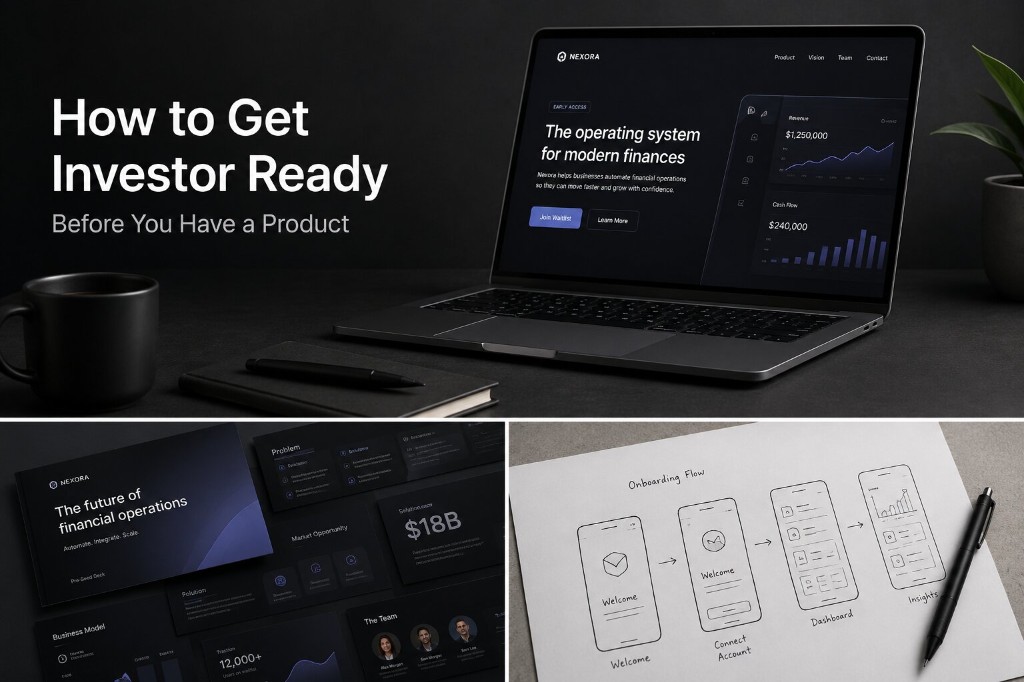
Most founders assume they need a finished product before they can pitch investors. They don’t.
At the pre-seed stage, investors are not always expecting a fully built product, a large engineering team, or months of traction. What they are trying to understand is much simpler: is this founder solving a real problem, in a real market, with enough clarity and credibility to be worth a deeper conversation?
That does not mean you can show up unprepared. A rough idea, a vague deck, and a generic landing page are not enough to create confidence. Before you ask someone to invest in your company, you need to make the opportunity easy to understand.
That is where most early-stage founders lose momentum.
They spend months thinking they need to finish the product first, when what they actually need is a clear investor-facing story, a credible startup website, a focused fundraising deck, and sometimes a simple prototype that shows how the product will work.
You do not need everything built. But you do need to look prepared.
What Investors Are Actually Looking For at Pre-Seed
At pre-seed, investors are rarely judging only the product. In many cases, the product is early, unfinished, or still being validated. What matters more is the strength of the overall opportunity.
Most investors are looking at four things: the story, the market, the founder, and the credibility signal.
The story answers the basic question: why does this need to exist? A strong founder can explain the problem, who has it, why now is the right time, and how the company becomes valuable if it works.
The market shows whether the idea has room to grow. Investors do not need every number to be perfect, but they do need to understand who the customer is, how painful the problem is, and why the opportunity could become big enough to matter.
The founder matters because early-stage investing is often a bet on the person as much as the product. Investors want to know why you are the right person to build this.
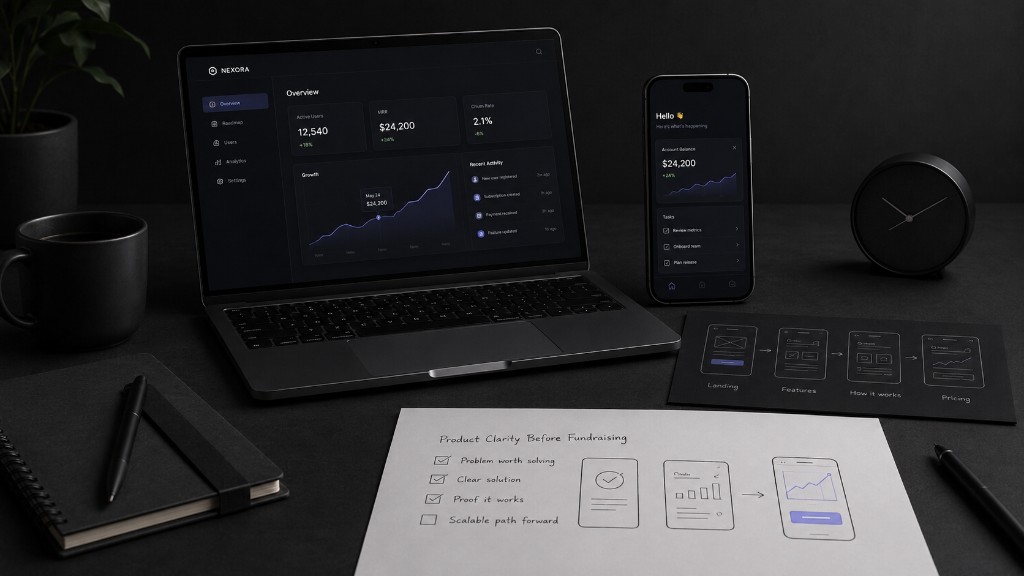
The credibility signal is everything that makes the company feel real before the product is fully built. That can include a polished website, a clear deck, a prototype, early customer conversations, waitlist interest, industry knowledge, or a focused product vision.
DocSend’s fundraising research shows how quickly investors review early-stage decks, which is why clarity matters so much. Their pre-seed pitch deck guide notes that investors spend less than 3.5 minutes on average reviewing a pre-seed deck.
Source: DocSend Pre-Seed Pitch Deck Guide
The Three Things You Need Before Your First Investor Meeting
Before your first investor meeting, you should have three core pieces in place.
| Investor-Ready Asset | What It Does | Why It Matters | When You Need It |
|---|---|---|---|
| Startup Website | Makes the company feel real and easy to understand | Investors, advisors, customers, and hires will look you up before or after a meeting | Before outreach starts |
| Fundraising Deck | Explains the opportunity, market, product, business model, team, and ask | Gives investors a clear reason to take the meeting or continue the conversation | Before warm intros or cold outreach |
| MVP Prototype or Demo | Shows how the product experience could work | Helps investors understand the product before it is fully built | When the product is hard to explain with words alone |
These three pieces work together. Your website builds trust. Your deck frames the opportunity. Your prototype or product visual helps people believe the experience can become real.
This is also the foundation behind Founder Product Sprint: an investor-ready website, pitch deck, and optional MVP prototype built around the founder’s story before the full product is finished.
Why Your Website Matters More Than You Think
A lot of founders treat the website as something they can handle later.
That is a mistake.
Investors will often look you up before or after a meeting. If your website is missing, unclear, generic, or disconnected from your pitch, it can weaken the impression you are trying to build.
A strong website does not need to be complicated. In fact, early-stage startup websites usually work best when they are simple and focused. The homepage should answer the core questions quickly: what are you building, who is it for, what problem does it solve, why does it matter now, and what should someone do next.
A generic website can make the company feel early in the wrong way. It may look like the founder has not clarified the story yet. A focused website, on the other hand, can make an early company feel sharper, more serious, and easier to evaluate.
Your website also supports more than fundraising. It gives early users a place to learn, advisors a place to reference, and potential hires a reason to believe there is a real company forming.
If your website is unclear, the pitch has to work harder. If your website is focused, the pitch has support before the meeting even starts.
Related service: Custom Website Design
What Makes a Fundraising Deck Actually Work
A fundraising deck works when it makes the opportunity easy to understand.
Most decks fail because they try to say too much. Founders often overload the deck with product details, long explanations, market research, roadmap ideas, and technical depth before the investor understands the basic story.
A good deck creates momentum. Each slide should make the next slide feel natural.
Y Combinator’s seed deck advice keeps the structure simple: company purpose, problem, solution, why now, market size, competition, product, business model, team, financials, and the ask. The exact order can change, but the goal stays the same: help investors understand the company quickly.
Source: Y Combinator Seed Round Pitch Deck Guide
The best fundraising decks are not just attractive. They are disciplined.
They remove noise. They use plain language. They focus on what investors need to understand quickly. They make it easy for someone to explain the company to another person after the meeting.
That is a useful test: after reading your deck, could someone describe your company in one or two clear sentences?
If not, the deck is not ready.
When a Prototype Makes Sense and When It Doesn’t
Not every founder needs a prototype before pitching.
A prototype makes sense when the product experience is hard to explain with words alone. This is common with SaaS products, mobile apps, marketplaces, dashboards, fintech products, AI tools, and workflow-heavy platforms.
If the investor needs to see the flow to understand the value, a clickable prototype can help. It gives the conversation something concrete. Instead of only saying what the product will do, you can show how a user would move through it.
A prototype is also useful when the product experience is part of the differentiation. If your advantage depends on workflow design, speed, simplicity, automation, or a new way of interacting with data, a prototype can make that advantage easier to understand.
The GV Design Sprint framework is built around a similar idea: answer important business questions through design, prototyping, and testing before committing to a full build.
Source: GV Design Sprint
But a prototype can become a distraction if the strategy is unclear. If you do not know who the product is for, what problem you are solving, or why the market matters, a clickable demo will not fix the pitch. It may make the idea look more designed, but not more convincing.
The order matters. Clarify the story first. Build the prototype only when it supports the story.
Related service: SaaS Product Design
Why Clarity Matters Before You Build
One of the biggest risks for early-stage founders is building too much before validating the direction.
CB Insights’ startup failure research points to issues like weak market need, running out of cash, and business model problems as major reasons startups fail. Those problems are not always caused by poor execution. Many times, they start earlier with unclear positioning, unclear customers, or unclear value.
Source: CB Insights: Top Reasons Startups Fail
That is why investor readiness should not be treated as making things look nice. The real value is forcing the hard questions before you spend months building.
A strong investor-facing website and deck make the company easier to understand. They help define who the product is for, why the problem matters, how the business could grow, and what needs to be built first. A prototype can then support that direction by making the product experience easier to see.
Together, these assets reduce confusion. They help founders explain the opportunity faster, get better feedback, and avoid building around assumptions that have not been tested.
Clarity does not replace product development. It makes product development more focused.
How Long Should This Actually Take?
Many founders spend months trying to get investor-ready.
Some of that time is useful. Most of it is wasted.
The delay usually comes from working on the wrong things in the wrong order. Founders keep changing the product before the story is clear. They redesign the website without knowing the pitch. They edit the deck repeatedly without a strong structure. They try to build too much before validating whether people understand the opportunity.
Getting investor-ready does not have to take months.
If the founder has the core idea, audience, and fundraising goal in place, the investor-facing materials can come together much faster. The work becomes less about inventing everything from scratch and more about organizing the company into a clear narrative.
That usually means defining the positioning first. Then the website. Then the deck. Then the prototype, if one is needed.
Speed matters because fundraising already takes time. You do not want to lose weeks preparing materials that could have been simplified much earlier. You want to get to better conversations faster.
The goal is not perfection. The goal is clarity strong enough to start the right conversations.
What to Do If You Are Raising in the Next 30 Days
If you are raising in the next 30 days, do not try to do everything at once.
Start with the story.
Write down the simplest version of what you are building, who it is for, what problem it solves, and why it matters now. If that does not feel clear, your website and deck will not feel clear either.
Next, build or refine the website. Keep it focused. You need a homepage or landing page that explains the company, communicates credibility, and gives people a next step. Do not overbuild it. Do not hide the main message behind clever language.
After that, focus on the deck. Make sure the structure is easy to follow. Cut anything that does not support the core fundraising story. Investors should be able to move through the deck quickly and understand the opportunity without needing a long explanation.
Then decide whether a prototype is necessary. If the product is easy to understand without one, you may not need it yet. If the experience is central to the pitch, create a clickable version that shows the most important flow.
Here is the practical order:
- Clarify the positioning and investor story
- Build a focused startup website
- Create the fundraising deck
- Add a prototype only if it strengthens the pitch
- Practice the investor walkthrough until the story feels natural
The biggest mistake is waiting until everything is finished before you start preparing.
You can be early and still look credible. You can be pre-product and still communicate clearly. You can be raising before the full build and still give investors enough confidence to take the next meeting.
The founders who stand out are not always the ones with the most polished product. They are often the ones who can explain the opportunity with the most clarity.
Get Investor Ready Faster
If you are preparing to raise, apply to an accelerator, or take your first investor meetings, your website, deck, and product story need to work together.
That is what Founder Product Sprint is built for.
In 10 days, you get the core investor-facing pieces in place: a premium startup website, a focused fundraising deck, and, if needed, a clickable MVP prototype for demos.
You do not need a finished product to start looking investor-ready.
You need clarity, credibility, and something investors can understand quickly.

